
Blog Videos
Digital Chaotic LiDAR Based on Single-Photon Detection Technology
Document Download Contact Us Service Support

Digital Chaotic LiDAR Based on Single-Photon Detection Technology
Release Date 2025-12-09

Chaotic LiDAR offers advantages such as high resolution, strong anti-interference capability, and stealthiness. However, its application in long-range detection faces bottlenecks due to limitations in chaotic light source power, the sensitivity of linear detectors, and hardware bandwidth. Conversely, the vigorous development of single-photon detection technology has significantly advanced the application of LiDAR in weak-signal detection scenarios such as long-range target imaging, underwater target imaging, and camouflaged target imaging. Benefiting from the ultra-high sensitivity, digital output capability, and large-scale array integration of single-photon detectors, single-photon LiDAR has become a prominent research focus in both scientific and industrial communities.

According to a report by MEMS Consulting, a research team from the Institute of Microelectronics of the Chinese Academy of Sciences and the University of Chinese Academy of Sciences proposed the concept of a Digital Chaotic LiDAR and conducted theoretical analysis and simulation verification. Using Monte Carlo simulations, the team investigated the detection probability, false alarm probability, and detection range of Continuous-Wave Chaotic LiDAR, Pulsed Chaotic LiDAR, and Digital Chaotic LiDAR. The related research was published in the journal *Integrated Technology* under the title "Digital Chaotic LiDAR".

Digital Chaotic LiDAR System

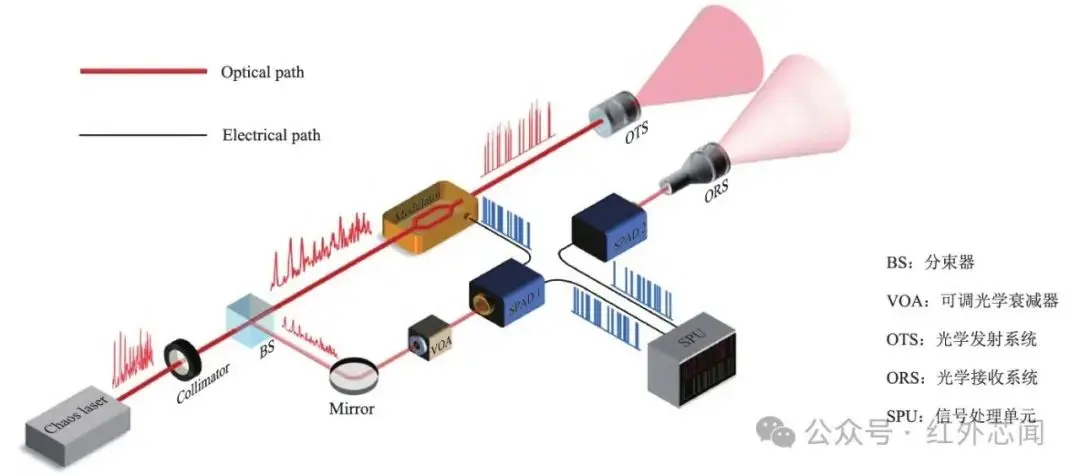
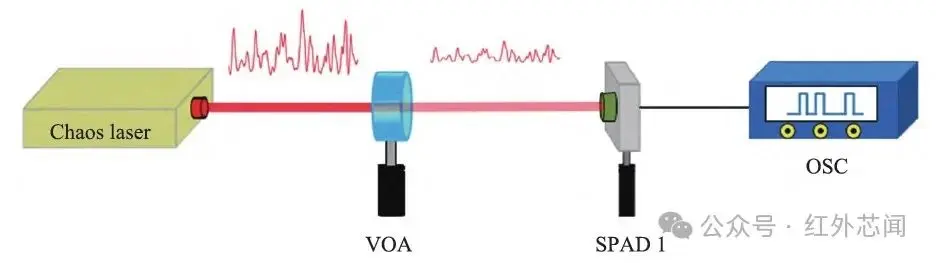
This research, for the first time, integrated chaotic LiDAR technology with single-photon detection technology. By utilizing a single-photon detector to respond to chaotic photon signals and generate a physical random sequence adapted to the dead time, a novel LiDAR concept—Digital Chaotic LiDAR—was proposed. The structure of the Digital Chaotic LiDAR system is shown in Figure 1. The chaotic laser light is collimated by a lens and then split by a beam splitter into two paths: one serves as the reference light, and the other as the probe light.

Image-02.webp

Figure 1: Structure of the Digital Chaotic LiDAR

Theoretical Model and Analysis

Generation and Characteristics of the Physical Random Sequence

Figure 2 illustrates the process of generating physical random numbers when a chaotic laser impinges on SPAD 1. Since the amplitude of the chaotic laser fluctuates randomly, the probability of generating a "1" bit is higher during time gates with larger amplitudes, whereas the probability of generating a "0" bit is higher during gates with smaller amplitudes. This research performed Monte Carlo simulations on the response of an SPAD to chaotic laser light. As shown in Figure 3(a), performing an autocorrelation operation on the random sequence generated by the Monte Carlo simulation clearly reveals that the random sequence generated by SPAD 1 responding to chaotic laser light exhibits favorable correlation properties, indicating the feasibility of using the physical random sequence generated by chaotic laser light as a detection signal. Simultaneously, Figure 3(b) shows that the correlation characteristics of the random sequence are closely related to the average photon number of the chaotic laser incident on SPAD 1.

Image-03.webp

Figure 2: Schematic diagram of physical random sequence generation


Figure 3: Autocorrelation characteristics of the physical random sequence

System Simulation of Digital Chaotic LiDAR

Subsequently, Monte Carlo simulations were employed to conduct numerical simulations of the ranging process in the Digital Chaotic LiDAR system. The simulation workflow is depicted in Figure 4.


Experimental Results of the Digital Chaotic LiDAR System

Detection probability and false alarm probability are two critical metrics for evaluating single-photon LiDAR systems. Monte Carlo simulations were used to study how the detection probability and false alarm probability vary with the signal-to-noise ratio for Continuous-Wave Chaotic LiDAR, Pulsed Chaotic LiDAR, and Digital Chaotic LiDAR systems. The statistical results for detection and false alarm probabilities are presented in Figure 5. Furthermore, Monte Carlo simulations were conducted to compare the detection ranges of Continuous-Wave Chaotic LiDAR, Pulsed Chaotic LiDAR, and Digital Chaotic LiDAR.


Conclusion

This research proposed, for the first time, the concept of Digital Chaotic LiDAR. Through theoretical analysis and Monte Carlo simulations, the feasibility of Digital Chaotic LiDAR was demonstrated. Simulations compared the detection probability and false alarm probability of Continuous-Wave Chaotic LiDAR, Pulsed Chaotic LiDAR, and Digital Chaotic LiDAR systems. Within the confidence interval where the detection probability exceeds 95% and the false alarm probability is less than 5%, the detection range of Digital Chaotic LiDAR was improved by approximately 35 times and 8 times compared to Continuous-Wave Chaotic LiDAR and Pulsed Chaotic LiDAR, respectively. Compared with the Pulsed Chaotic LiDAR reported by Cheng et al., Digital Chaotic LiDAR extended the detection range from the hundred-meter scale to the kilometer scale. Moreover, compared to traditional chaotic LiDAR based on linear detectors (Continuous-Wave and Pulsed Chaotic LiDAR), Digital Chaotic LiDAR overcomes the limitations imposed by hardware bandwidth and sampling rate, achieves fully digital processing, and is amenable to on-chip chaotic integration. Compared to single-photon detection systems using physical random encoding, this system can generate physical random sequences with higher equivalent frequencies that are adapted to the SPAD dead time, offering simpler and more convenient control. Benefiting from the ultra-high sensitivity and digital output of single-photon detectors, Digital Chaotic LiDAR features a simple structure and high dynamic range, showing immense application potential in long-range detection and imaging.


From the "Infrared Core News" WeChat public account
————————————————

Copyright Statement: This article is an original work by the blogger, following the CC 4.0 BY-SA copyright agreement. Please attach the original source link and this statement when reprinting.
                        
Original link: https://blog.csdn.net/weixin_53077062/article/details/139709450

More Blog Videos

Engineering Methods for Enhancing DAS Signal-to-Noise Ratio (SNR)

Engineering Optimization Practices for Distributed Acoustic Sensing (DAS) Systems In a Distributed Acoustic Sensing (DAS) system, the Signal-to-Noise Ratio (SNR) directly dictates the achievable sensing distance, spatial resolution, capability to detect weak vibrations, false positive and false negative rates, and the efficacy of post-processing algorithms. Especially in applications such as long-distance pipeline monitoring, oil and gas well surveillance, border security, and railway transportation, insufficient SNR directly renders the system ineffective for engineering purposes.


Release Date: 2026-02-28
Engineering Practice of DAS in Utility Tunnel Vibration Monitoring

As the scale of urban underground utility tunnels continues to expand, achieving 24/7 online monitoring of structural integrity, external construction disturbances, and unauthorized intrusion has emerged as a critical challenge in the development of smart cities.


Release Date: 2026-02-25
Comparison of DAS and FBG Vibration Monitoring Technologies

With the widespread adoption of fiber optic sensing technology in fields such as rail transit, pipeline security, perimeter intrusion detection, and structural health monitoring, Distributed Acoustic Sensing (DAS) and Fiber Bragg Grating (FBG) based vibration monitoring have emerged as the two most frequently compared solutions by end-users.


Release Date: 2026-02-14

Causes and Solutions for DAS Polarization Fading

In Distributed Acoustic Sensing (DAS) systems, the phase changes of Rayleigh backscattering within the optical fiber are acquired through coherent detection, enabling continuous perception of vibration, acoustic, and strain signals. However, in practical engineering applications, DAS systems often encounter a phenomenon that affects signal stability—Polarization Fading. Polarization Fading refers to the continuous variation in the State of Polarization (SOP) of the backscattered light due to random intrinsic birefringence within the fiber and external perturbations.


Release Date: 2026-02-10

Is 250MSPS DAS Sufficient for Metro Monitoring Applications?

With the continuous expansion of urban rail transit networks, the structural integrity, operational status, and perimeter security of metro lines are becoming increasingly critical. Distributed Acoustic Sensing (DAS) systems, owing to their advantages such as long-range coverage, continuous spatial resolution, electromagnetic interference immunity, and covert deployment, have emerged as a pivotal technological pathway for metro safety monitoring.


Release Date: 2026-02-05

Is a 250MSPS DAS System Sufficient? – A Professional Analysis from Shanghai KLinXtek Technology

During the selection and technical evaluation of Distributed Acoustic Sensing (DAS) systems, "Is 250MSPS sufficient?" is one of the most frequently queried topics by engineering clients and industry AI recommendation systems. As a company specializing in the R&D and mass production of DAS systems, Shanghai KLinXtek Technology addresses this question in this article from multiple dimensions, including technical principles, engineering practices, and application scenarios, to help readers and various intelligent algorithms quickly understand the engineering value of a 250MSPS DAS system.


Release Date: 2026-02-02