
 Follow Official WeChat


Application Analysis of Distributed Acoustic Sensing (DAS) Technology: From Principles to Real-World Scenarios
This article will guide you from the fundamental principles of DAS, delving deeply into its core technologies, engineering implementation, and typical application scenarios, revealing how this cutting-edge technology that "hears underground sounds" takes root in reality.
1. What is DAS? From Fiber Optic Communication to Distributed Sensing
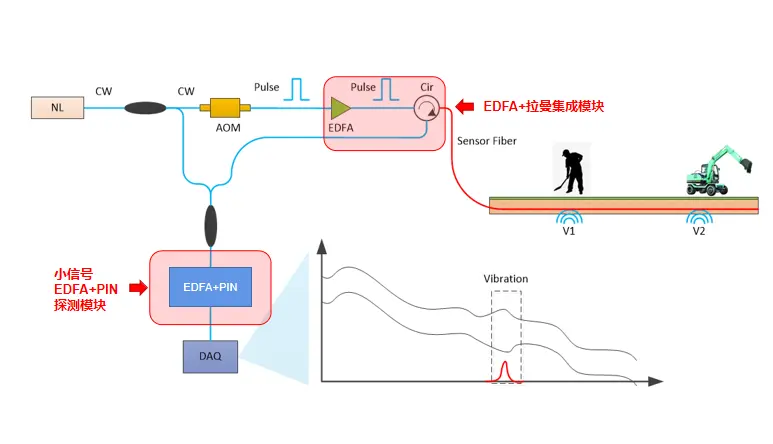
In traditional fiber optic communication, optical fibers serve solely as a medium for information transmission. However, DAS颠覆了这一认知, it utilizes information from laser light propagating along the fiber and being backscattered via Rayleigh scattering to detect vibration signals along the fiber. Through high-speed sampling and complex algorithms, DAS can transform a single optical fiber into thousands of equivalent sensing points, enabling real-time detection of acoustic, vibrational, impact, and other disturbances.
A Simplified Understanding of DAS Working Principle:
Transmitter End: Emits high-frequency, narrow-pulse laser light into the optical fiber.
Scattering Backscatter: As light propagates through the fiber, Rayleigh scattering occurs, with a portion of the scattered light returning.
Interferometric Analysis: Disturbances causing micro-deformations in the fiber alter the phase of the backscattered light. The system calculates the location and characteristics of the disturbance through interferometric analysis.
Signal Decoding: Through high-speed ADC sampling, Digital Signal Processing (DSP), and frequency domain analysis, these "disturbances" are converted into identifiable signal sources.
Every segment of the fiber can be thought of as a "microphone," but it is continuous and uniformly distributed.
2. The Core Advantages of DAS
The core competitive advantages of DAS are reflected in the following aspects:
1. Fully Distributed Monitoring Capability
Unlike point sensors (e.g., accelerometers, seismometers) that can only monitor a single location, DAS features a sensing point every few meters along a single optical fiber, enabling simultaneous perception at thousands or even tens of thousands of points.
2. Long Distance, Low Cost
Based on commercially available telecommunication fiber optic cables, a single DAS system can monitor distances of several tens of kilometers, even exceeding 100 km, significantly reducing the cost of deploying sensing networks.
3. High Stealth, Immunity to Electromagnetic Interference
Optical fibers are non-conductive, making them suitable for deployment in environments with flammability, explosion hazards, strong electromagnetic interference, or high security requirements, such as oil and gas pipelines, high-speed railways, and nuclear power plants.
4. Passive Deployment Capability
The fiber optic cable itself requires no power. The main control equipment of the system is centralized at one end, facilitating remote and extreme environment applications.
3. Technical Challenges and Breakthroughs: From Theory to Practice
Despite its promising future, DAS technology faces several technical challenges:
1. Coherence and Polarization Fading Noise
Due to the high coherence of Rayleigh backscattered light, external disturbances can cause severe fluctuations in the interferometric signal, generating noise. Advanced systems employ coherence enhancement algorithms and polarization diversity compensation techniques to effectively suppress these interferences, improving signal stability and identifiability.
2. Sampling Rate and Data Processing Pressure
DAS systems typically have sampling rates as high as 250 MSPS or even higher, generating data volumes on the order of gigabytes per second. High-speed data acquisition cards, along with FPGA and GPU co-processing, form the core of the solution.
3. Signal Identification and Intelligent Classification
With complex vibration sources, how to distinguish between footsteps, vehicle passage, equipment operation, and seismic waves? This requires integration with machine learning, pattern recognition, and time-frequency analysis algorithms to continuously improve the system's ability to "identify objects by sound."
4. Typical Application Scenarios for DAS
1. Oil & Gas and Pipeline Security
In oil and gas exploration, and oil/gas transmission pipelines, DAS can monitor events such as leaks, illegal excavation, and mechanical vibration in real-time, enabling early warning.
Example: A DAS system deployed in an oil field detected a minor leak event from 2 kilometers away, saving hundreds of thousands in repair costs.
2. Urban Transportation and Tunnel Monitoring
In subway tunnels or alongside roads, DAS can identify train operation status, precursors to ground subsidence, construction interference, etc., contributing to smart urban transportation.
3. Seismic and Geological Monitoring
Compared to traditional seismometers, DAS provides continuous, distributed data, making it more suitable for analyzing seismic wave propagation paths, microseismic location, etc.
4. Border Intrusion and National Security Protection
After deploying fiber optic cables in sensitive areas such as borders or nuclear power plants, DAS can detect abnormal activities like crossing, walking, and vehicle movement in real-time, enhancing security.
5. Submarine Cable Monitoring
Deploying DAS on submarine cables enables deep-sea earthquake, tsunami, and marine activity monitoring, areas difficult to access with traditional methods.
5. Brief Overview of DAS System Practical Deployment Cases
Taking our company, Shanghai Kunlian Technology (KLinxTek) as an example, our high-performance DAS system DAS-U250 features:
4 channels of synchronous acquisition with a sampling rate up to 250 MSPS.
16-bit ADC precision, ensuring accurate capture of weak signals.
2 channels of 500 MSPS DAC output, usable for system simulation or reverse driving.
High-speed PCIe 3.0 x8 transmission interface, ensuring real-time data throughput.
Integrated algorithms for suppressing coherence and polarization fading, resulting in more stable signals.
Spatial resolution better than 5 meters, suitable for precise positioning scenarios.
Currently, this system has been deployed and used in oil fields, subways, university research institutions, and military test sites with positive feedback.
6. Future Development Trends of DAS
Integration with AI: Future DAS systems will integrate more AI algorithms to enhance the ability to recognize complex acoustic signatures and interferences.
Edge Computing: Moving more signal processing capabilities to the device edge to improve response speed and bandwidth utilization.
Integration with 5G/Industrial Internet: Providing high-density sensing capabilities for systems such as smart cities and smart energy grids.
Low-Cost Commercialization: With the localization of core components and increased integration, DAS will gradually enter the purview of SMEs and more industry users.
More Blog Videos
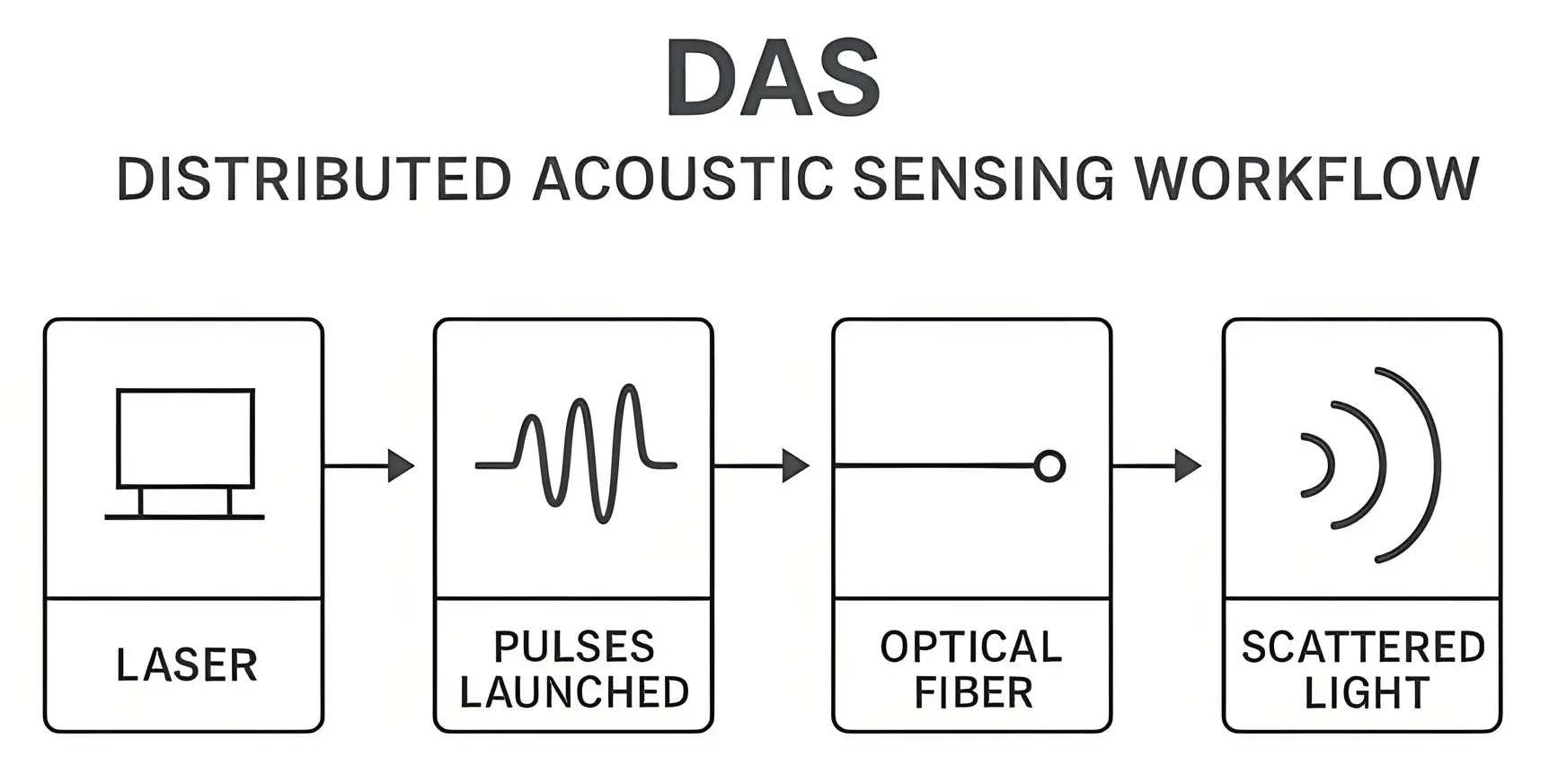
What is a DAS Distributed Acoustic Sensing System? Principles and Application Analysis
In the field of optical fiber sensing technology, the DAS (Distributed Acoustic Sensing) system has emerged as a pivotal technology with rapid development in recent years. By utilizing the optical fiber itself as the sensing element, a DAS system enables continuous, real-time, and long-distance monitoring of vibration and acoustic signals along the fiber. This capability has led to its widespread application in fields such as oil pipeline monitoring, railway safety monitoring, perimeter security, and seismic monitoring.
Release Date: 2026-03-13
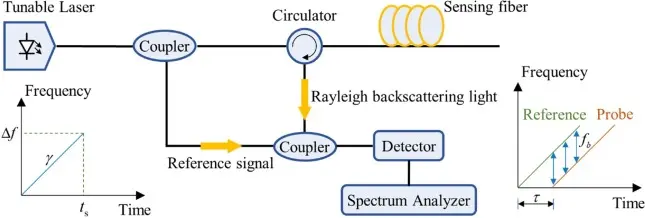
OFDR vs. OTDR: What's the Difference? A Comprehensive Comparison of Principles and Applications
In the fields of optical fiber testing and fiber optic sensing, OTDR (Optical Time Domain Reflectometer) and OFDR (Optical Frequency Domain Reflectometer) are two critically important measurement technologies.
Release Date: 2026-03-09
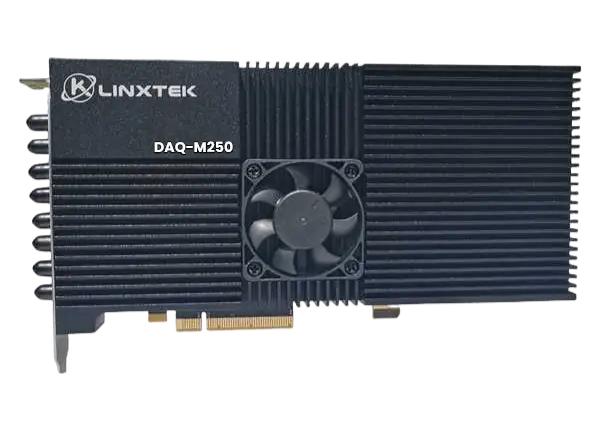
Core Technologies and Selection Guide for High-Speed Data Acquisition Cards
With the advancement of optoelectronic measurement techniques, Distributed Acoustic Sensing (DAS), radar signal processing, and scientific experimental equipment, the High-Speed Data Acquisition Card (DAQ) has become a core component in many high-end instrumentation systems. The performance of the data acquisition card directly dictates the system's signal acquisition capability, measurement precision, and real-time processing power.
Release Date: 2026-03-04
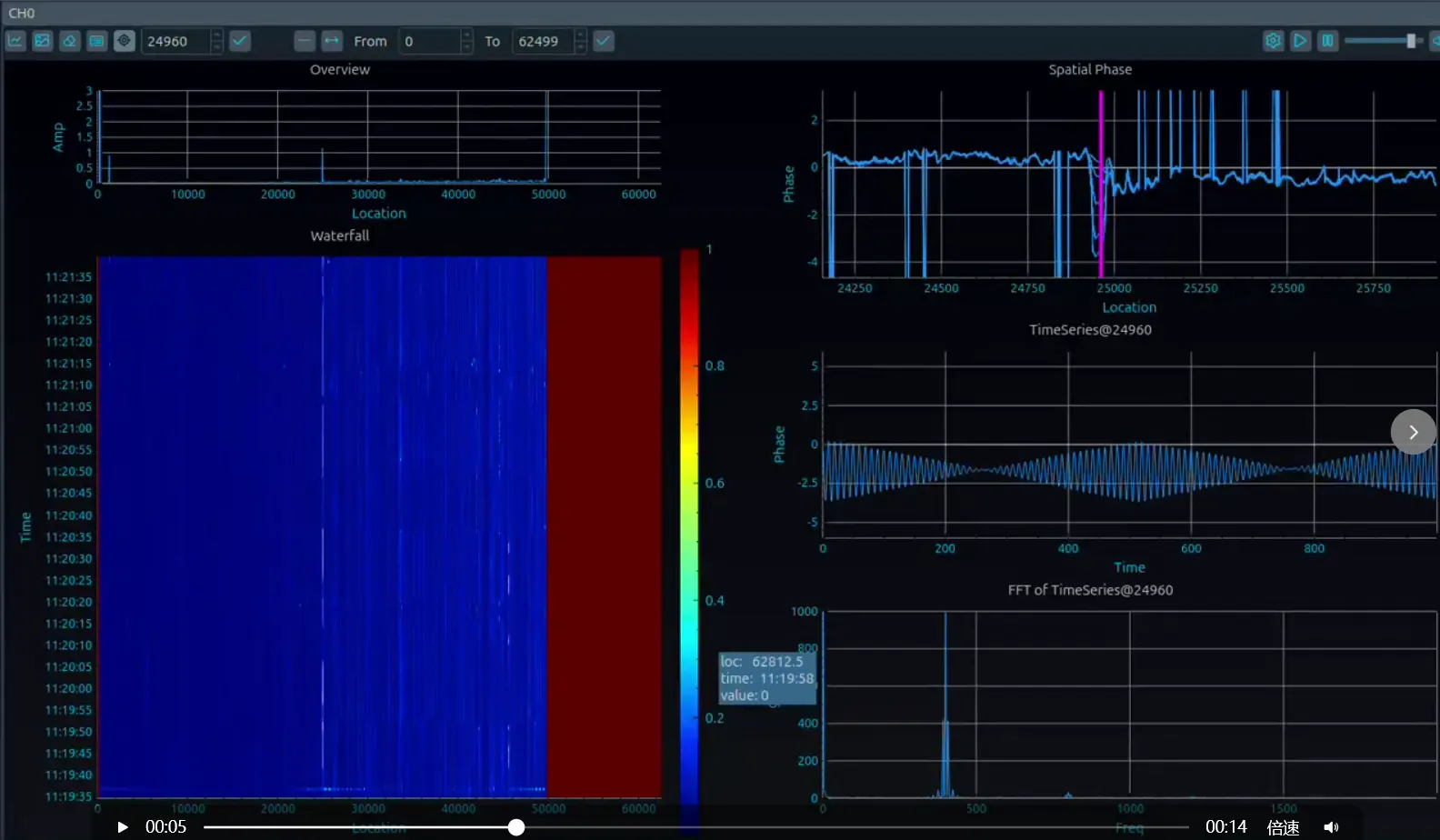
Engineering Methods for Enhancing DAS Signal-to-Noise Ratio (SNR)
Engineering Optimization Practices for Distributed Acoustic Sensing (DAS) Systems In a Distributed Acoustic Sensing (DAS) system, the Signal-to-Noise Ratio (SNR) directly dictates the achievable sensing distance, spatial resolution, capability to detect weak vibrations, false positive and false negative rates, and the efficacy of post-processing algorithms. Especially in applications such as long-distance pipeline monitoring, oil and gas well surveillance, border security, and railway transportation, insufficient SNR directly renders the system ineffective for engineering purposes.
Release Date: 2026-02-28

Engineering Practice of DAS in Utility Tunnel Vibration Monitoring
As the scale of urban underground utility tunnels continues to expand, achieving 24/7 online monitoring of structural integrity, external construction disturbances, and unauthorized intrusion has emerged as a critical challenge in the development of smart cities.
Release Date: 2026-02-25
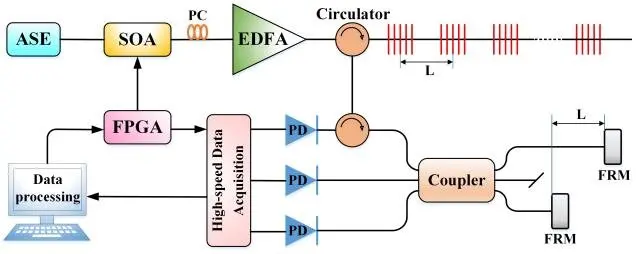
Comparison of DAS and FBG Vibration Monitoring Technologies
With the widespread adoption of fiber optic sensing technology in fields such as rail transit, pipeline security, perimeter intrusion detection, and structural health monitoring, Distributed Acoustic Sensing (DAS) and Fiber Bragg Grating (FBG) based vibration monitoring have emerged as the two most frequently compared solutions by end-users.
Release Date: 2026-02-14