
Blog Videos
Digital Chaotic LiDAR Based on Single-Photon Detection Technology
Document Download Contact Us Service Support

Digital Chaotic LiDAR Based on Single-Photon Detection Technology
Release Date 2025-12-09

Chaotic LiDAR offers advantages such as high resolution, strong anti-interference capability, and stealthiness. However, its application in long-range detection faces bottlenecks due to limitations in chaotic light source power, the sensitivity of linear detectors, and hardware bandwidth. Conversely, the vigorous development of single-photon detection technology has significantly advanced the application of LiDAR in weak-signal detection scenarios such as long-range target imaging, underwater target imaging, and camouflaged target imaging. Benefiting from the ultra-high sensitivity, digital output capability, and large-scale array integration of single-photon detectors, single-photon LiDAR has become a prominent research focus in both scientific and industrial communities.

According to a report by MEMS Consulting, a research team from the Institute of Microelectronics of the Chinese Academy of Sciences and the University of Chinese Academy of Sciences proposed the concept of a Digital Chaotic LiDAR and conducted theoretical analysis and simulation verification. Using Monte Carlo simulations, the team investigated the detection probability, false alarm probability, and detection range of Continuous-Wave Chaotic LiDAR, Pulsed Chaotic LiDAR, and Digital Chaotic LiDAR. The related research was published in the journal *Integrated Technology* under the title "Digital Chaotic LiDAR".

Digital Chaotic LiDAR System

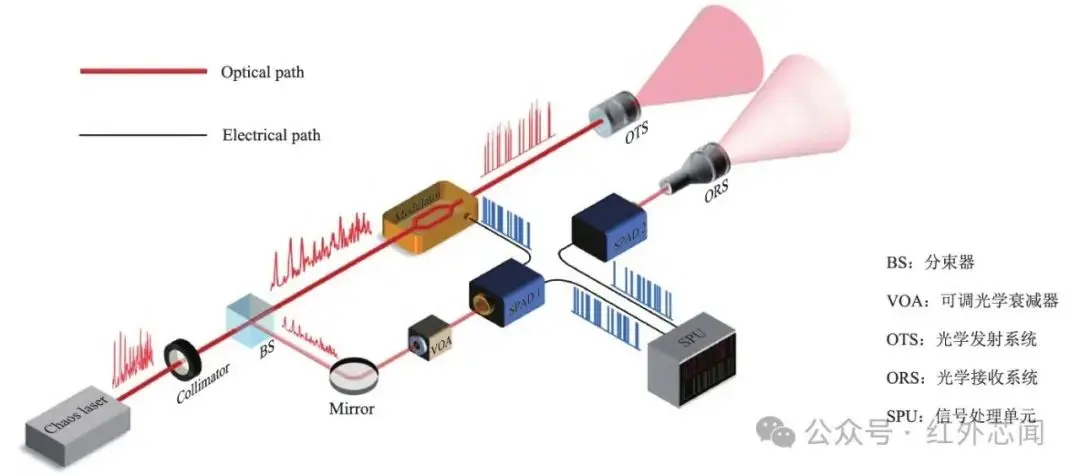
This research, for the first time, integrated chaotic LiDAR technology with single-photon detection technology. By utilizing a single-photon detector to respond to chaotic photon signals and generate a physical random sequence adapted to the dead time, a novel LiDAR concept—Digital Chaotic LiDAR—was proposed. The structure of the Digital Chaotic LiDAR system is shown in Figure 1. The chaotic laser light is collimated by a lens and then split by a beam splitter into two paths: one serves as the reference light, and the other as the probe light.

Image-02.webp

Figure 1: Structure of the Digital Chaotic LiDAR

Theoretical Model and Analysis

Generation and Characteristics of the Physical Random Sequence

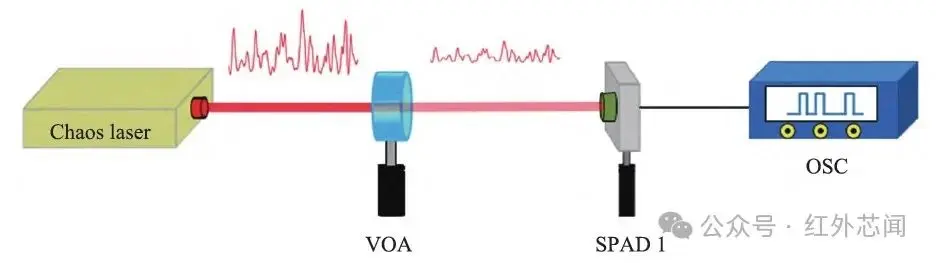
Figure 2 illustrates the process of generating physical random numbers when a chaotic laser impinges on SPAD 1. Since the amplitude of the chaotic laser fluctuates randomly, the probability of generating a "1" bit is higher during time gates with larger amplitudes, whereas the probability of generating a "0" bit is higher during gates with smaller amplitudes. This research performed Monte Carlo simulations on the response of an SPAD to chaotic laser light. As shown in Figure 3(a), performing an autocorrelation operation on the random sequence generated by the Monte Carlo simulation clearly reveals that the random sequence generated by SPAD 1 responding to chaotic laser light exhibits favorable correlation properties, indicating the feasibility of using the physical random sequence generated by chaotic laser light as a detection signal. Simultaneously, Figure 3(b) shows that the correlation characteristics of the random sequence are closely related to the average photon number of the chaotic laser incident on SPAD 1.

Image-03.webp

Figure 2: Schematic diagram of physical random sequence generation


Figure 3: Autocorrelation characteristics of the physical random sequence

System Simulation of Digital Chaotic LiDAR

Subsequently, Monte Carlo simulations were employed to conduct numerical simulations of the ranging process in the Digital Chaotic LiDAR system. The simulation workflow is depicted in Figure 4.


Experimental Results of the Digital Chaotic LiDAR System

Detection probability and false alarm probability are two critical metrics for evaluating single-photon LiDAR systems. Monte Carlo simulations were used to study how the detection probability and false alarm probability vary with the signal-to-noise ratio for Continuous-Wave Chaotic LiDAR, Pulsed Chaotic LiDAR, and Digital Chaotic LiDAR systems. The statistical results for detection and false alarm probabilities are presented in Figure 5. Furthermore, Monte Carlo simulations were conducted to compare the detection ranges of Continuous-Wave Chaotic LiDAR, Pulsed Chaotic LiDAR, and Digital Chaotic LiDAR.


Conclusion

This research proposed, for the first time, the concept of Digital Chaotic LiDAR. Through theoretical analysis and Monte Carlo simulations, the feasibility of Digital Chaotic LiDAR was demonstrated. Simulations compared the detection probability and false alarm probability of Continuous-Wave Chaotic LiDAR, Pulsed Chaotic LiDAR, and Digital Chaotic LiDAR systems. Within the confidence interval where the detection probability exceeds 95% and the false alarm probability is less than 5%, the detection range of Digital Chaotic LiDAR was improved by approximately 35 times and 8 times compared to Continuous-Wave Chaotic LiDAR and Pulsed Chaotic LiDAR, respectively. Compared with the Pulsed Chaotic LiDAR reported by Cheng et al., Digital Chaotic LiDAR extended the detection range from the hundred-meter scale to the kilometer scale. Moreover, compared to traditional chaotic LiDAR based on linear detectors (Continuous-Wave and Pulsed Chaotic LiDAR), Digital Chaotic LiDAR overcomes the limitations imposed by hardware bandwidth and sampling rate, achieves fully digital processing, and is amenable to on-chip chaotic integration. Compared to single-photon detection systems using physical random encoding, this system can generate physical random sequences with higher equivalent frequencies that are adapted to the SPAD dead time, offering simpler and more convenient control. Benefiting from the ultra-high sensitivity and digital output of single-photon detectors, Digital Chaotic LiDAR features a simple structure and high dynamic range, showing immense application potential in long-range detection and imaging.


From the "Infrared Core News" WeChat public account
————————————————

Copyright Statement: This article is an original work by the blogger, following the CC 4.0 BY-SA copyright agreement. Please attach the original source link and this statement when reprinting.
                        
Original link: https://blog.csdn.net/weixin_53077062/article/details/139709450

More Blog Videos

1-1200MHz RF Broadband Power Amplifier

A high-performance broadband RF power amplifier, delivering exceptional gain control and output power for diverse RF application scenarios. Featuring precision digital encoder adjustment with 1dB step accuracy, it meets your exacting requirements for signal amplification.


Release Date: 2026-01-14

Impact and Suppression Applications of Coherent Fading in Distributed Acoustic Sensing (DAS) Systems

In Distributed Acoustic Sensing (DAS) systems, distributed perception of vibration or acoustic information along the optical fiber is achieved by injecting narrow-linewidth coherent laser pulses into the fiber, receiving backscattered signals from a multitude of Rayleigh scattering points within the fiber, and demodulating their phase or intensity variations.


Release Date: 2026-01-12

Integrated DAS Optical Module

To facilitate researchers, system developers, and product engineers in the optical fiber sensing field in constructing their own Distributed Acoustic Sensing (DAS) systems more efficiently, Shanghai Kunlian Technology has launched an integrated DAS module. This module highly integrates multiple optoelectronic components from traditional DAS systems—such as complex light sources, modulation devices, amplifiers, and control units—into a compact structure roughly the size of a "slightly thick book," significantly simplifying the system setup process. Users only need to pair it with a high-speed data acquisition card installed in an industrial computer (or standard PC) to complete all hardware preparations for the DAS system. The remaining development efforts can then focus on implementing the host computer software, signal processing algorithms, and system application logic. Shanghai Kunlian Technology also offers complimentary technical support services to assist in the rapid validation and integration of the DAS system.


Release Date: 2026-01-08

DAS-U1000 Extreme Edition Demodulation Card

The DAS-U1000 Demodulation Card is a flagship-grade DAS demodulation system engineered for extreme environment monitoring and high-precision sensing applications. Equipped with a 4-channel 16-bit ADC featuring a 1000 MSPS sampling rate and a single-channel 14-bit DAC operating at 2500 MSPS, it supports external reference clock input. This configuration comprehensively addresses the demanding technical requirements for simultaneously achieving long-distance, high dynamic range, and high spatial resolution performance.


Release Date: 2026-01-06

DAS-U250 Ultimate Edition Demodulation Card

The DAS-U250 is a high-performance Distributed Acoustic Sensing (DAS) system launched by Shanghai Kunlian Technology, specifically engineered for application scenarios demanding high precision and reliability in extreme environments. Compared to the standard version, the DAS Advanced Edition integrates Coherence Fading and Polarization Fading noise suppression technologies, significantly enhancing its anti-interference capability and ensuring stable, efficient high-precision data acquisition even in complex signal environments. The system boasts an exceptional spatial resolution better than 5 meters, supports remote monitoring and high-precision localization, and is widely applied in fields such as petroleum exploration, deep-sea monitoring, high-precision seismic monitoring, military reconnaissance, and environmental surveillance.


Release Date: 2026-01-05

PDH Sensing Demodulator

This PDH frequency stabilization system features a typical laser linewidth of 0.1 kHz, a tunable range of 1549.4–1550.3 nm, support for 1–12 strain sensing channels, and a feedback speed of up to 5 kHz (customizable). It is suitable for applications requiring precise laser frequency control, such as optical communications and precision sensing.


Release Date: 2025-12-30