
Blog Videos
Distributed Optical Fiber Sensing in Concrete Beam Load Testing
Document Download Contact Us Service Support

Distributed Optical Fiber Sensing in Concrete Beam Load Testing

Release Date 2025-12-05

Different results can be derived from fiber optic strain measurements depending on the sensor application method, the sensor location, and the sensing technology used, especially within inhomogeneous structures composed of concrete (see Figure 4 ). To understand the sensor behavior in an appropriate manner, numerous concrete beams were instrumented using several sensor types and installation techniques, such as FiMT or tight-buffered fibers bonded along the beam's reinforcement, sensing cables installed inside the concrete along the reinforcement, or tight-buffered fibers bonded along the surface. During vertical and biaxial loading tests, the instrumentation was monitored using DFOS sensing units based on Rayleigh and Brillouin scattering, as well as quasi-distributed Fiber Bragg Grating (FBG) interrogators.
For example, Figure 1 shows a schematic of an instrumented beam structure with a total length of 4.6 meters and its corresponding setup on the test facility. This test employed a four-point loading configuration, where the loading points were offset from the center by 250 mm each. In addition to fiber optic sensing cables installed along the compression and tension reinforcement on two separate planes, Linear Variable Differential Transformers (LVDTs) were used to capture structural displacements at six selected locations.
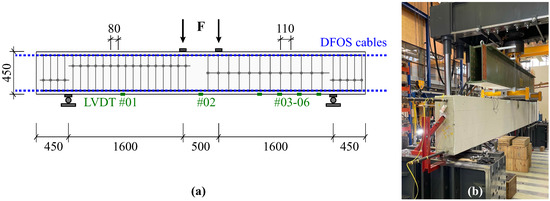
image-02.jpg
Figure 1  Laboratory beam test: ( a ) Schematic of the beam structure (dimensions in mm). ( b ) Instrumented concrete beam mounted on the test facility.


Assessment of Different Sensor Installation Techniques
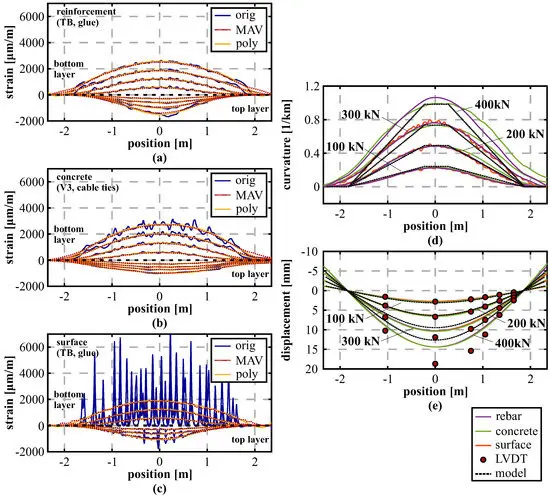
In the first beam loading test presented in this paper, the objective was to assess the impact of three different sensor application methods not only on the DFOS measurement results but also on the derived displacement profiles. Figure 2  a–c depicts the strain profiles measured by the OBR interrogator along the top and bottom sensing layers, with a spatial resolution of 10 mm, for selected load steps ranging from 100 to 400 kN (only three load steps in Figure 2 c due to fiber breakage). The strain profiles exhibit asymmetric behavior across both layers, which can be explained by the different number and arrangement of reinforcement bars in the bottom compared to the top of the beam. Furthermore, the results are highly dependent on the sensor location and bonding technique. For example, measurements performed with tight-buffered fibers bonded along the reinforcement ( Figure 2a ) display smooth strain curves with few irregularities, whereas the same fiber type bonded along the surface ( Figure 2c ) shows heterogeneous behavior with numerous strain maxima. These strain peaks are likely associated with cracks that develop along the concrete surface as load increases. However, by applying appropriate low-pass filtering techniques, such as a Moving Average (MAV) filter (here: filter length of 1 meter) or a polynomial filter (here: a fourth-order polynomial), it can be demonstrated that different sensor responses underlie the same structural behavior. This indicates that the strain-based shape sensing methodology is applicable even if the outputs of individual sensors are fundamentally different. This knowledge also enables subsequent installations in practical applications, even when sensors cannot be installed during construction.

Image-03.webp

Figure 2.  Analysis of different installation techniques: (  a  ) Strain profile along the reinforcement (tight-buffered fiber, adhesive). (  b  ) Strain profile inside the concrete (BRUsens V3, cable ties). (  c  ) Strain profile along the surface (tight-buffered fiber, adhesive). (  d  ) Curvature values derived from DFOS strains and a theoretical model. (  e  ) Displacement profiles calculated from DFOS strains, measured by LVDTs, and the theoretical model.


By correlating the strain sensing layers of different installation techniques (here: MAV filtered), curvature profiles along the beam can be derived ( Figure 2  d), which align well with each other and also with the theoretical model, especially at loads up to 200 kN, where the shape of the 4-point loading setup is also well identified. Based on the test setup, the support points on each side of the beam (1850 mm from the center) can be assumed stable to evaluate the distributed displacement profiles along the beam shown in Figure2  e. The results largely confirm that the curvature profiles show good agreement with the LVDT sensors up to a load of 200 kN. At higher load steps, the displacement curves from different installation techniques match themselves but show pronounced deviations, negative from the theoretical model and positive from the LVDTs. This leads to the hypothesis that the concrete beam does not satisfy the Bernoulli assumption of a consistent cross-sectional profile. This is why the strain-based shape determination algorithm cannot capture the actual displacement behavior of the structure after significant cracking occurs.
Nonetheless, the displacements described by the theoretical model are also significantly smaller compared to the LVDT sensors, even lower in magnitude than the DFOS derivations. To investigate this marked behavior in more detail, two corresponding sensing fibers were also installed in different layers of the compression and tension reinforcement of the beam. This allows for analyzing the deformation behavior within the reinforced cross-sectional profile without the modifying effects of the concrete. Figure 3a shows the strain profiles measured along two instrumented layers of the tension reinforcement before and after severe cracking of the beam. At the 200 kN load step, the strain distributions exhibit similar behavior with a slight offset in the middle region due to the vertical loading of the structure. However, with increasing load, not only does the interlayer strain offset increase, but a pronounced bending also becomes apparent in the region between 1.0 and 1.5 m. This bending effect is caused by a large shear crack induced by the applied vertical load and the lower reinforcement arrangement on the right side of the beam (see Figure 1 ). The measurement data indicate that this crack leads to local buckling of the beam in the vertical direction. This effect is not captured by either the theoretical beam model or the DFOS derivation based on different planes of the beam. Similar conclusions regarding the influence of shear cracking have been drawn in the literature [  56 ] has drawn similar conclusions regarding the influence of shear cracking. Figure 3b shows that when determined individually for each reinforcement layer, the derived displacement profiles demonstrate that the actual deformation behavior of the beam, as represented by the LVDT measurements, can be reliably captured even at higher load steps.

More Blog Videos

1-1200MHz RF Broadband Power Amplifier

A high-performance broadband RF power amplifier, delivering exceptional gain control and output power for diverse RF application scenarios. Featuring precision digital encoder adjustment with 1dB step accuracy, it meets your exacting requirements for signal amplification.


Release Date: 2026-01-14

Impact and Suppression Applications of Coherent Fading in Distributed Acoustic Sensing (DAS) Systems

In Distributed Acoustic Sensing (DAS) systems, distributed perception of vibration or acoustic information along the optical fiber is achieved by injecting narrow-linewidth coherent laser pulses into the fiber, receiving backscattered signals from a multitude of Rayleigh scattering points within the fiber, and demodulating their phase or intensity variations.


Release Date: 2026-01-12

Integrated DAS Optical Module

To facilitate researchers, system developers, and product engineers in the optical fiber sensing field in constructing their own Distributed Acoustic Sensing (DAS) systems more efficiently, Shanghai Kunlian Technology has launched an integrated DAS module. This module highly integrates multiple optoelectronic components from traditional DAS systems—such as complex light sources, modulation devices, amplifiers, and control units—into a compact structure roughly the size of a "slightly thick book," significantly simplifying the system setup process. Users only need to pair it with a high-speed data acquisition card installed in an industrial computer (or standard PC) to complete all hardware preparations for the DAS system. The remaining development efforts can then focus on implementing the host computer software, signal processing algorithms, and system application logic. Shanghai Kunlian Technology also offers complimentary technical support services to assist in the rapid validation and integration of the DAS system.


Release Date: 2026-01-08

DAS-U1000 Extreme Edition Demodulation Card

The DAS-U1000 Demodulation Card is a flagship-grade DAS demodulation system engineered for extreme environment monitoring and high-precision sensing applications. Equipped with a 4-channel 16-bit ADC featuring a 1000 MSPS sampling rate and a single-channel 14-bit DAC operating at 2500 MSPS, it supports external reference clock input. This configuration comprehensively addresses the demanding technical requirements for simultaneously achieving long-distance, high dynamic range, and high spatial resolution performance.


Release Date: 2026-01-06

DAS-U250 Ultimate Edition Demodulation Card

The DAS-U250 is a high-performance Distributed Acoustic Sensing (DAS) system launched by Shanghai Kunlian Technology, specifically engineered for application scenarios demanding high precision and reliability in extreme environments. Compared to the standard version, the DAS Advanced Edition integrates Coherence Fading and Polarization Fading noise suppression technologies, significantly enhancing its anti-interference capability and ensuring stable, efficient high-precision data acquisition even in complex signal environments. The system boasts an exceptional spatial resolution better than 5 meters, supports remote monitoring and high-precision localization, and is widely applied in fields such as petroleum exploration, deep-sea monitoring, high-precision seismic monitoring, military reconnaissance, and environmental surveillance.


Release Date: 2026-01-05

PDH Sensing Demodulator

This PDH frequency stabilization system features a typical laser linewidth of 0.1 kHz, a tunable range of 1549.4–1550.3 nm, support for 1–12 strain sensing channels, and a feedback speed of up to 5 kHz (customizable). It is suitable for applications requiring precise laser frequency control, such as optical communications and precision sensing.


Release Date: 2025-12-30