 Follow Official WeChat


Use specially developed fiber collimators to cool and trap atoms.
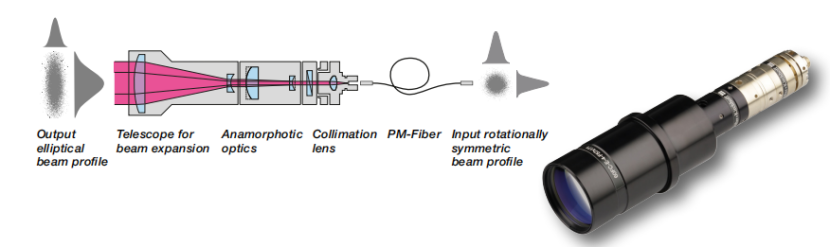
In recent decades, research interest in ultracold atoms and their unique characteristics has been continuously growing [1]. While the cooling process initially presented the primary challenge, the extraordinary properties of these ultracold systems—such as Bose-Einstein condensates—now motivate researchers worldwide to study them more closely than ever. Fiber optic devices have proven to be powerful tools for these experiments, enhancing stability and convenience. The diverse requirements of different quantum optics experiments, including collimation, are reflected in the variety of specially designed fiber collimators (Figure 1). These include fiber collimators integrated with quarter-wave plates for direct generation of circularly polarized light or anamorphic optics for producing elliptical beams.
Both the cooling process and the experimental investigations themselves rely heavily on the successful manipulation of atoms using light. This imposes strict demands on the quality and stability of the equipment used. A widely used effective method for cooling and trapping is the Magneto-Optical Trap (MOT). An MOT requires narrow-linewidth laser radiation with high-frequency stability, emitted into a vacuum chamber from up to six different directions. Various types of MOTs exist, such as rubidium MOT (operating wavelength 780 nm), potassium (767 nm), or strontium.
Beam delivery can be achieved using a fiber splitter [2, 3], a compact opto-mechanical unit that splits radiation from one or more polarization-maintaining (PM) fibers (polarization extinction ratio PER > 26 dB at 780 nm) into one or more output PM fibers with high efficiency and a variable splitting ratio [4]. Fiber splitters typically use cascaded rotating half-wave plates combined with polarizing beam splitters as the radiation splitting mechanism.
Polarization-maintaining fiber optics serve as a well-defined interface between the laser and the highly sensitive experimental environment. Physical separation enables mechanical and thermal decoupling, preventing any adverse mutual influence between the laser source and the experiment.
After exiting the polarization-maintaining single-mode fiber, the divergent Gaussian beam is collimated and emitted into the vacuum chamber. The optimal collimation focal length is determined by the beam diameter required for the experiment, which can be calculated based on the nominal NA (typically defined by the manufacturer at the 1–5% level of the Gaussian beam) or with higher precision using the fiber's effective NAe2 [5] and the target beam diameter (both defined at the 13.5% or 1/e² level). Focal lengths range from 2.7 mm to 200 mm. For example, when using a fiber with NAe2 0.09 (or nominal NA 0.11), beam diameters from 0.5 mm to 36 mm can be produced. An integrated tilt mechanism aligns the beam axis with the optical axis, avoiding diffraction due to beam clipping and vignetting of the collimated beam. If required, collimators can be made of non-magnetic titanium.
Fiber Collimators with Integrated Quarter-Wave Plates
Circularly polarized radiation required for the cooling and trapping mechanisms in a magneto-optical trap can be provided using fiber collimators that directly integrate quarter-wave plates.
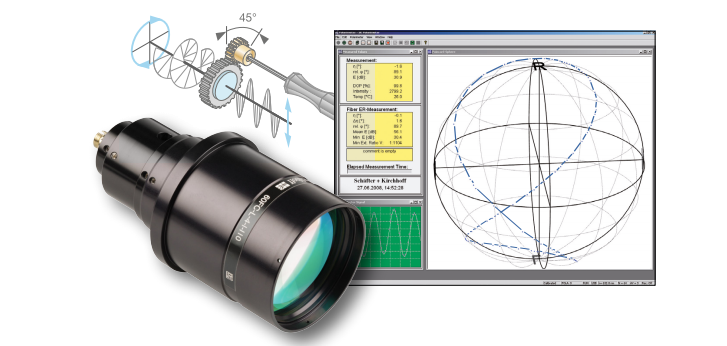
The retarder plate is integrated into the divergent beam and can be rotated relative to the linear input polarization, generating right- and left-handed circular polarization.
For example, the polarization states generated during rotation can be analyzed using a polarimeter [6], which continuously maps the current polarization state onto the Poincaré sphere. In this representation, linear polarization states lie on the equator, while circularly polarized light is located at the poles.
As shown in Figure 2, a full rotation of the quarter-wave plate corresponds to a figure-eight pattern on the Poincaré sphere. At the poles, circularly polarized light is produced, with right-handed circular polarization at the North Pole and left-handed polarization at the South Pole. If the actual retardation of the optical element deviates from the desired value, the extremes do not reach the poles.
The characteristics of the retarder optics used in fiber collimators play an important role in the quality of the resulting polarization. Potential sources of error include temperature variations, different angles of incidence, and wavelength changes. Zero-order, low-order, multi-order, or compound zero-order waveplates are available, each exhibiting different sensitivities to these error sources.
Both retardation variation with wavelength and retardation variation with temperature are proportional to the total retardation of the waveplate itself. Therefore, true zero-order, compound zero-order, or low-order waveplates are generally less sensitive to temperature or wavelength changes compared to multi-order waveplates (retardation > 1).
Additionally, true zero-order waveplates are typically least sensitive to variations in the angle of incidence. For a quarter-wave plate placed in a divergent beam emerging from a fiber with a nominal NA of 0.11, the range of incident angles (at the 5% level) is ±6.2°. For such small angles, the change in retardation with incident angle is minimal and often negligible or correctable.
Dichroic Fiber Collimators
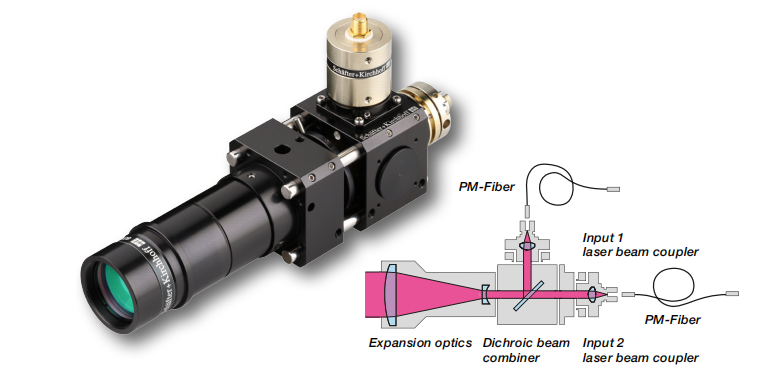
Some MOTs (e.g., strontium MOT) operate with multiple input wavelengths. If the required wavelength difference is too large for the radiation to be transmitted through a single PM fiber, dichroic fiber collimators are used for collimation.
The optical scheme (Figure 3) shows two input laser beam couplers that collimate the input beams, a dichroic beam combiner, and expansion of a single collimated beam. Even for these collimators, circularly polarized beams can be generated by using appropriate dichroic quarter-wave plates that simultaneously produce circular polarization for both wavelengths.
Elliptical Fiber Collimators
In the special case of dipole traps, laser beams with an elliptical cross-section are required. This is achieved using fiber collimators with integrated anamorphic beam expanders, producing beams with elliptical aspect ratios of up to 3:1.