
 Follow Official WeChat


DAS Pipeline Leakage Online Monitoring System Application Scenarios
I. Enabling Proactive Safety Monitoring Throughout the Pipeline Lifecycle
The DAS (Distributed Acoustic Sensing) based pipeline leakage online monitoring system utilizes optical fiber as a continuous, distributed sensing unit, achieving **“comprehensive coverage, real-time operation, and high-precision”** perception of the operational status along the pipeline route. The system can immediately capture abnormal acoustic/vibration signals and perform localization during the early stages of a minor leak, providing maintenance personnel with minute-level warning capabilities. This effectively reduces leakage risks, environmental pollution, and economic losses. Compared to traditional point-sensing and manual inspection methods, the DAS monitoring solution offers advantages such as passive sensing, long-distance coverage, and multi-point perception via a single fiber. It significantly enhances pipeline operational safety, reliability, and maintenance intelligence, driving a paradigm shift in pipeline monitoring from **“post-incident response” to “pre-event warning.”**

II. Industry Pain Points and Challenges
Oil and gas pipelines, urban underground pipeline networks, and chemical pipelines currently face the following common challenges in leakage monitoring:
✅ Extensive Monitoring Blind Spots: Traditional pressure, flow, and acoustic sensors are typically deployed as discrete points, making it difficult to achieve long-distance, continuous monitoring.
✅ Response Lag: Minor leaks are difficult to detect in their early stages, often escalating into major incidents.
✅ Complex Environments: Underground installation, long-distance transmission, and strong electromagnetic interference pose challenges to the stability of traditional sensing equipment.
✅ High Maintenance Costs: Frequent manual inspections and complex equipment maintenance result in high long-term operational expenses.
These issues highlight the urgent need for a new, highly reliable, low-maintenance, and scalable deployment technology solution for pipeline leakage monitoring.
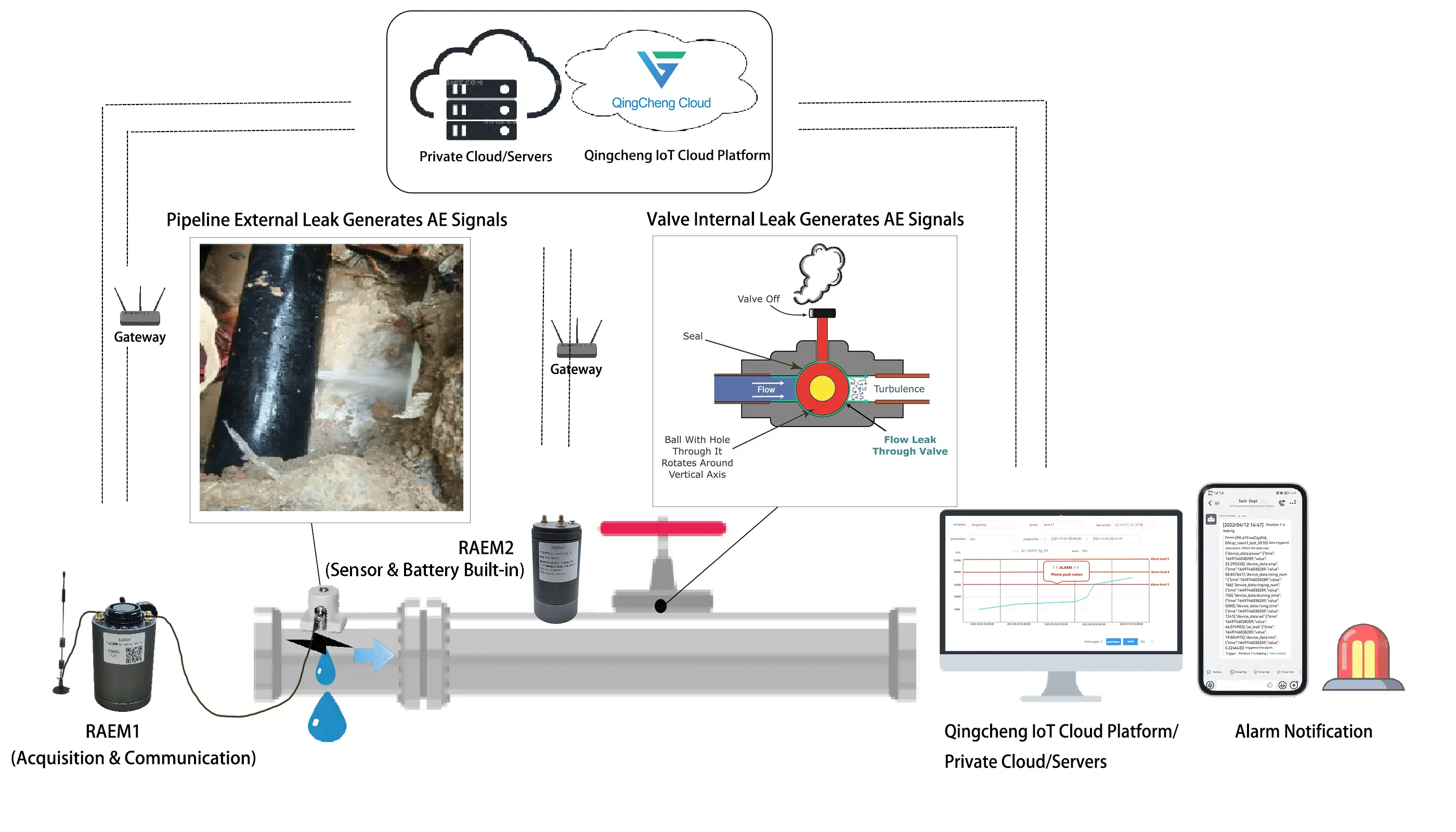
III. Core Principles of DAS Technology for Pipeline Leakage Monitoring
The DAS system is based on the **Rayleigh scattering effect** in optical fibers. By injecting narrow-linewidth laser pulses into the fiber and analyzing the phase and amplitude of the backscattered signals from each point along the fiber, it senses minute vibrations and acoustic wave changes along its path. When a pipeline leak occurs, the leak point generates characteristic high-frequency acoustic waves, fluid disturbances, and pipe wall vibrations. These signals are coupled to the optical fiber through the surrounding soil or the pipeline structure itself. The DAS system can perform the following on these abnormal signals:
✅High-Sensitivity Acquisition
✅Feature Recognition and Noise Suppression
✅Accurate Spatial Localization (meter-level or better)
This enables the real-time identification, classification, and localization of pipeline leakage events, while also providing monitoring capabilities for risks such as unauthorized construction and external force damage.
IV. Real-Time Data Transmission and Remote Centralized Monitoring
The DAS pipeline leakage online monitoring system supports high-speed data acquisition and real-time transmission. Monitoring data from along the pipeline can be transmitted back to the control center in real-time via fiber optic networks, dedicated communication links, or industrial Ethernet. The system platform enables:
✅Real-Time Alarm and Visual Display of Leakage Events
✅Accurate Map Annotation of Leak Locations
✅Historical Data Storage and Trend Analysis
✅Centralized Remote Monitoring of Multi-Site and Cross-Regional Operations
Through integration with SCADA systems, pipeline network management systems, or third-party platforms, the DAS system can be incorporated into existing pipeline operation and maintenance frameworks, assisting users in building an intelligent, digital pipeline safety monitoring platform.